Process
The development of Hexy involved balancing intelligent software with robust hardware. The steps followed included:
- Imagining the Robot
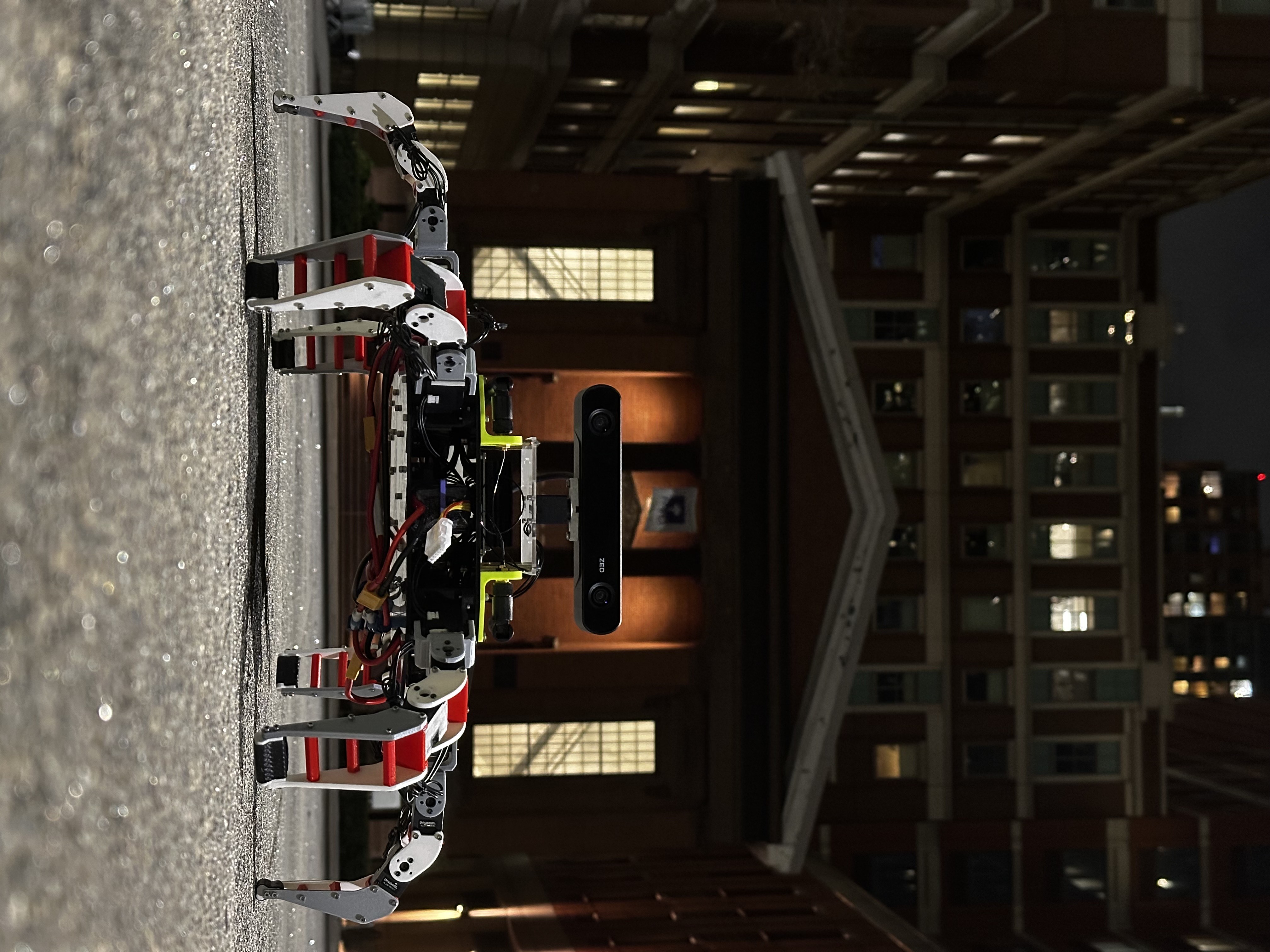
The process began with a question: how could a robot be built that adapts to the world rather than simply following commands? This led to the adoption of a six-legged design that is stable, flexible, and durable for rough terrain. - Building the Hardware
A custom power board was designed to operate 18 motors across Hexy’s six legs. The system was optimized for compactness and real-time responsiveness, with continuous monitoring of joint movement for coordinated walking. - Programming the Brain
A predictive controller was implemented to compute optimal steps in real time. This was paired with an inverse kinematics solver running on a Jetson Nano, allowing rapid decision-making. - Teaching it to See and Feel
A camera and IMU were integrated onboard to determine Hexy’s position and orientation. These were fused using sensor algorithms to ensure balance on uneven terrain. - Simulating and Fine-Tuning
Prior to physical deployment, Hexy’s movements were simulated using tools like Pinocchio for kinematics and CoppeliaSim for dynamics. These tools allowed for refined motion planning while maintaining computational efficiency. - Putting it to the Test
Following simulation, Hexy was tested in real-world environments. Lab floors and outdoor terrains were used to iteratively improve locomotion and control in live settings.